.jpg)
You have no items in your shopping cart.
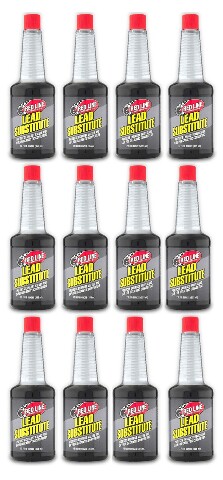
$189.99

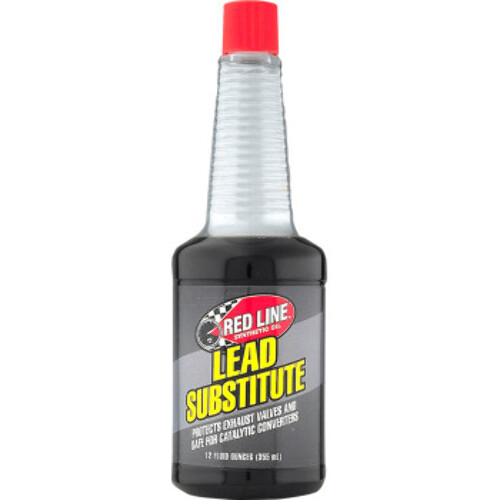
Prevents valve seat damage in engines designed for leaded gasoline
Prolongs the useful life of older engines without updated valve seats
Cleans carburetor deposits and injectors, safe for catalytic converters
One bottle treats up to 25 gallons
For racing, marine or off-road use only.
Don't need a case? Buy Each Here
Specs
Prolongs the useful life of older engines without updated valve seats
Cleans carburetor deposits and injectors, safe for catalytic converters
One bottle treats up to 25 gallons
For racing, marine or off-road use only.
Don't need a case? Buy Each Here
Specs
| Product Name | Fuel Additive |
| Model | Lead Substitute |
| Container Size | 355 ml / 12 US fl oz. |
| Packaging | 12 per Case |
| Units | Case of 12 |
| Riding Style | Adventure Touring / Dual-Sport / Street / Snow / Off-Road / Watercraft |
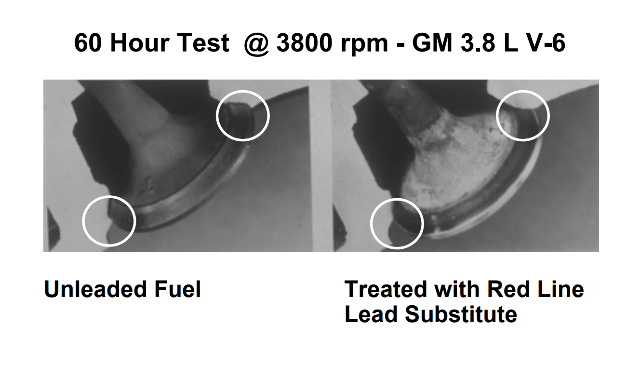
RED LINE® LEAD SUBSTITUTE is a safe and effective valve seat protection additive which is designed for use in engines which require the protection of lead. Tetraethyl lead was originally designed as an octane enhancer, but it was soon discovered that the metallic oxides which result from combustion form a protective coating on valves which prevent microwelding of the valve seat to the valve face under high temperature operation.
This welding of the two hot pieces of metal causes the removal of the softer seat metal and subsequent recession of the valve into the cylinder head. Wear debris then contributes to valve stem and valve guide wear. Valve recession causes poor sealing of the compression gases, which means loss of power and fuel economy, poor idle and driveability, and the eventual need for cylinder head replacement.
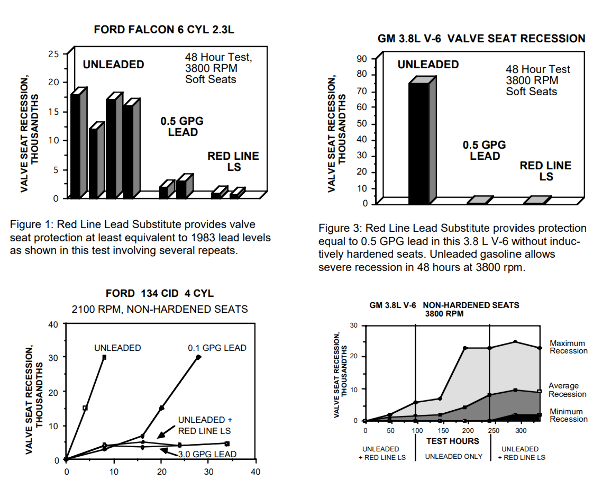
Red Line Lead Substitute provides the same valve seat protection as obtained with lead concentrations in the range of 0.5 - 3.0 grams per gallon. This is achieved by using sodium-based chemistry which forms sodium oxides upon combustion and provides the same physical protection from welding and subsequent metal removal as did lead oxides.
When compared to levels of lead present in the leaded supreme of prior years, Red Line Lead Substitute provides equivalent protection for valves and none of the detrimental side effects which can be found with other additives.
BENEFIT SUMMARY
-
Reduces valve seat recession
-
Cleans carburetor and injector deposits
-
Reduces intake valve and port deposits
-
Concentrated for economical use
WHICH ENGINES REQUIRE VALVE PROTECTION?
Current automotive engines use a valve seat hardening process to reduce the microwelding and subsequent metal removal which causes valve seat recession. By 1971 most cars were tolerant of unleaded gasoline and by 1975 all cars had hardened valve seats.
However, even recent production truck engines, marine engines, and farm equipment may not be so tolerant of unleaded gasoline. This is because the induction hardening may not be sufficient to protect equipment which will encounter sustained high-speed or high-load operation. Many manufacturers find it necessary to use special hard inserts instead.
Check the owners manual to see if your engine requires valve seat protection. If the engine has been rebuilt, only the supplier of the head can tell you whether you need valve seat protection, since rebuilt heads can have either soft or hardened seats.
HOW MUCH LEAD IS REQUIRED?
Prior to 1983, the leaded gasolines of many gasoline marketers contained lead contents in the range of 3.0 GPG (grams per gallon). Due to an awareness of the toxic nature of lead in the environment, the EPA has enforced a schedule for the elimination of lead.
TIMING MAXIMUM LEAD LEVEL
|
Timing |
Maximum Lead Level |
|---|---|
|
Nov. 1982 |
1.1 GPG (grams per gallon) |
|
July 1985 |
0.5 GPG |
|
Jan. 1986 |
0.1 GPG |
|
Jan. 1988 |
0 |
The EPA has come under severe criticism from agricultural, marine, and automotive interests for their apparent disregard of equipment which requires the protection of lead.
But is 0.1 GPG lead enough?
The literature shows that there are numerous variables which determine valve seat recession. The major variable is valve seat temperature which can be strongly influenced by speed, load, and fuel mixture. Leaner mixtures can produce exhaust which is several hundred degrees hotter than rich mixtures.
The EPA has been strongly criticized by some engine manufacturers for the limited data used to justify their 0.1 GPG maximum. One study used shows recession with 0.04 GPG lead and no recession with 0.07 GPG. This test was run in a 350 V-8 under mild conditions for only 100 hours.
Another study showed that 0.5 and 0.2 GPG lead provided equal valve seat recession to 3.0 GPG in a V-8 operated under mild conditions at less than 1/2 throttle. They chose to disregard a reference which these authors made to car manufacturer's tests at 4400 rpm which showed that 0.25 GPG caused recession and 0.5 GPG lead was required for protection.
GM recently stated that 0.2 GPG is a more reasonable risk. Chrysler found that 0.5 GPG was inadequate to prevent valve seat wear in two V-8 engines under high output conditions.
PROOF OF PERFORMANCE
Red Line Lead Substitute is a safe and effective means to reduce valve seat recession. The following data is proof of the effectiveness of Red Line Lead Substitute in a wide variety of engines and operating conditions.
This product has successfully protected engines in millions of miles of operation without harmful side effects.
HEAVY-DUTY EQUIPMENT
GM's owners manuals for their medium and heavy-duty trucks tell an interesting story. The manuals specified unleaded or low-lead gasoline for their 1971-1974 models and unleaded for their 1975-1978 models.
Apparently, because of durability problems, GM changed their owners manuals to recommend only leaded gasoline for the 1979 and later models. International Harvester's manual for their 1984 trucks states that continuous use of unleaded gasoline can cause excessive valve seat wear.
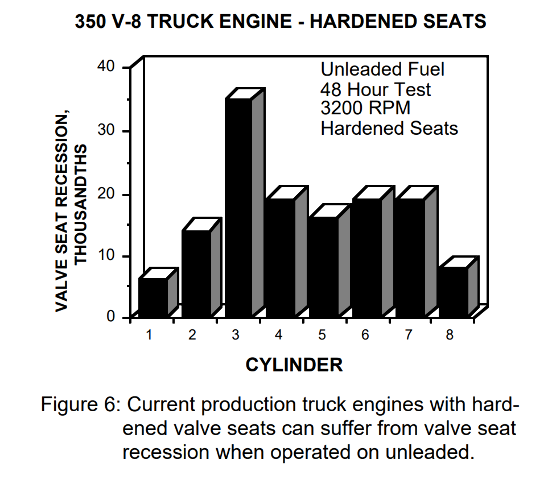
Thus, even engines equipped with hardened seats can require an additive to prevent wear. The following chart shows that a current production 350 V-8 with hardened valve seats can suffer from valve seat recession when operated on unleaded fuel.
AGRICULTURAL EQUIPMENT
Agricultural equipment is quite often operated at full-load conditions which makes this equipment very susceptible to valve seat recession. Much of the older equipment has been rebuilt, which makes it difficult to determine whether hardened seats were used at rebuild.
Many engines used in agricultural equipment require the protection equivalent to 0.5 GPG lead.
MARINE ENGINES
Marine engines are often operated at or near the rated speed and load conditions, which is more severe service than even most heavy-duty trucks. For this reason, valve seat protection is required in most marine equipment.
Although some owners manuals allow the use of unleaded fuel, full-throttle service may cause valve seat recession even with hardened seats.
Testing with unleaded fuel in several engines from different manufacturers - all with hardened seats - has shown 60 - 80 thousandths recession in 150 - 250 hours. Red Line Lead Substitute has virtually eliminated recession in the same test involving more than 60 marine engines.
CLEANS CARBURETORS AND INJECTORS
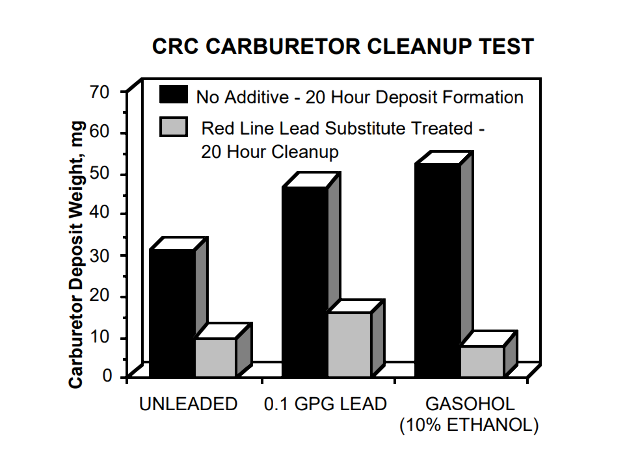
Red Line Lead Substitute contains detergents which can clean carburetors, injectors, and valves and keep them clean. This helps provide optimal fuel mixtures to restore fuel efficiency and reduce exhaust emissions.
SAFE FOR CATALYTIC CONVERTERS
Red Line Lead Substitute has been tested for 10,000 miles in five recent model cars equipped with three-way catalyst systems. Emissions tested according to the EPA procedure showed no significant changes.
SAFE FROM HARMFUL SIDE EFFECTS
Industry standard tests to determine engine cleanliness and engine wear have shown that Red Line Lead Substitute has no detrimental effect on engine wear or cleanliness.
Although the additive works by depositing sodium oxides to prevent welding, these deposits are not abrasive and do not build up in the combustion chamber. Tests show the octane requirement increase when using Red Line Lead Substitute to be no greater than expected with unleaded fuel. In fact, the additive seems to significantly reduce ring land deposits.
There are many other lead replacements currently marketed and it is difficult for the consumer to evaluate the protective qualities each. Some have tried a potassium version of our chemistry, but have encountered failures due to valve sticking.
Others try to simply "lubricate" the valve seats with upper cylinder oil. The temperatures involved are much to great for simple lubricants. Some give you leaded race gas in a can designed to provide 0.1 GPG lead - which can be ineffective for many uses. Still others attempt to phosphide or nitride the surfaces.
Ask for proof - before your engine becomes an experiment!
DIRECTIONS FOR USE
Red Line Lead Substitute is recommended to be used at 1 oz per 10 gallons in any grade of gasoline. Very severe service such as sustained full-load operation and overly lean combustion may require 1.5 to 2 oz per 10 gallons.
Although there is a carry-over effect, intermittent use of the additive may not provide the proper protection when you need it most.
Red Line Lead Substitute has been tested at levels up to 4 oz per 10 gallons and has shown that occasional overdosing will not cause problems.
Red Line Lead Substitute is packaged in 12 ounce bottles which treat 120 gallons, and 5 gallons to treat 6,400 gallons. Both provide the most concentrated form of effective protection available.
Red Line Lead Substitute is not sold for street use. Its use is permited for racing, marine, and off-road use only.
DESIGNED FOR PERFORMANCE
Red Line Synthetic Oil Corporation is the leader in lubricant and fuel system chemistry. Red Line manufactures a full line of automotive products which are designed to provide noticeable improvements in performance.
